Polygonal Annotation
for Complex Shapes
High-fidelity polygon labelling for objects that resist rectangular boxes — rooftops, agricultural plots, anatomical structures, and irregular industrial components.
Shape-Accurate
Object Labelling
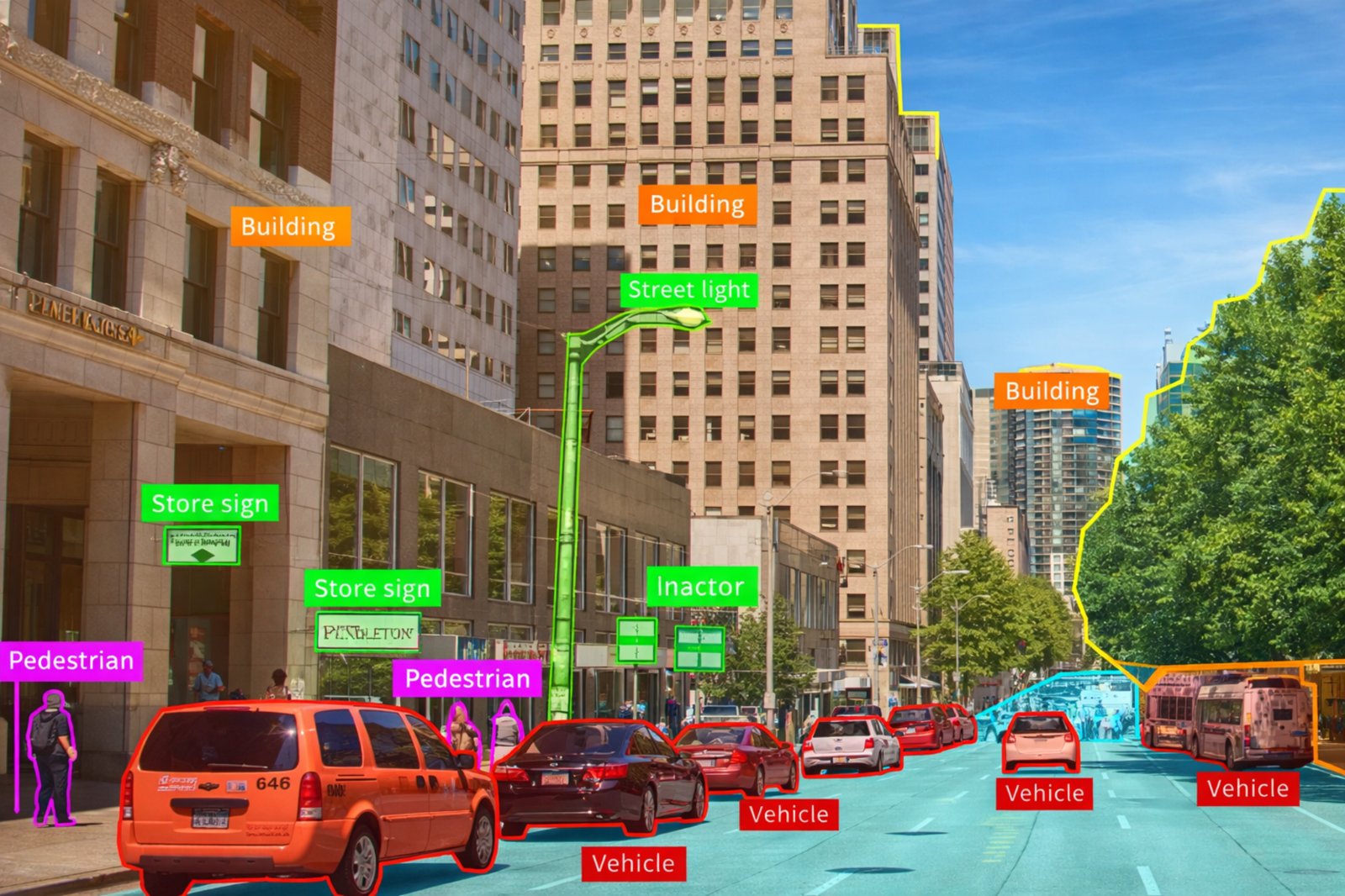
Polygonal annotation traces the exact boundary of non-rectangular objects using a series of vertices connected into a polygon. This produces far richer training data than bounding boxes.
Our teams excel at high-vertex-count polygons for agricultural boundaries, building footprints, and fine-grained medical annotation.
- High-vertex polygon tracing for complex shapes
- Building and rooftop footprint annotation
- Agricultural plot and field boundary delineation
- Medical structure and anatomical contour labelling

Precision for Every Contour
We support annotation in standard polygon formats and integrate directly with GIS tools like QGIS and ArcGIS. All polygons validated for topology correctness.
Where Polygonal Annotation
Powers Real AI
Rooftop Detection
Building footprint annotation for solar potential, insurance risk, and urban planning AI.
Precision Agriculture
Crop field boundaries from satellite and drone imagery for yield monitoring and resource allocation.
Medical AI
Anatomical structure delineation for radiology and pathology AI models in CT, MRI, and histopathology.
Geospatial Mapping
Land parcel, road network, and water body boundary annotation for GIS and cadastral AI systems.
Industrial QA
Component and defect shape annotation for manufacturing quality assurance AI.
Environmental Monitoring
Forest cover, deforestation, and wetland extent mapping from satellite imagery.
How We Deliver
Annotation Excellence
Guideline Calibration
Vertex count, topology rules, and boundary snapping tolerances defined per object class.
Polygon Pilot
Sample images annotated and reviewed for boundary accuracy and topological validity.
Production Annotation
Scalable annotation with per-polygon QA and inter-rater agreement monitoring.
Validation & Delivery
Self-intersection checks, gap detection, and topology validation on every batch.
Why Impact Outsourcing
for Polygonal Annotation?
Exact Boundaries
Polygons follow the true object outline with minimised vertex count and maximised fidelity.
GIS Integration
Native support for GeoJSON, Shapefile, GeoPackage. Direct integration with QGIS and ArcGIS.
Medical Grade
Certified workflows for diagnostic AI with biomedical-trained annotators.
Data Security
ISO 27001 certified. Satellite, aerial, and medical imagery stays confidential.
Rapid Scaling
Millions of polygons per month with consistent quality.
Cost Advantage
Premium polygon quality at 40-60% lower cost than US/EU alternatives.
Ready to Scale Your Polygonal Annotation?
Get a custom quote within 24 hours. Our team is ready to discuss your dataset requirements and timeline.